

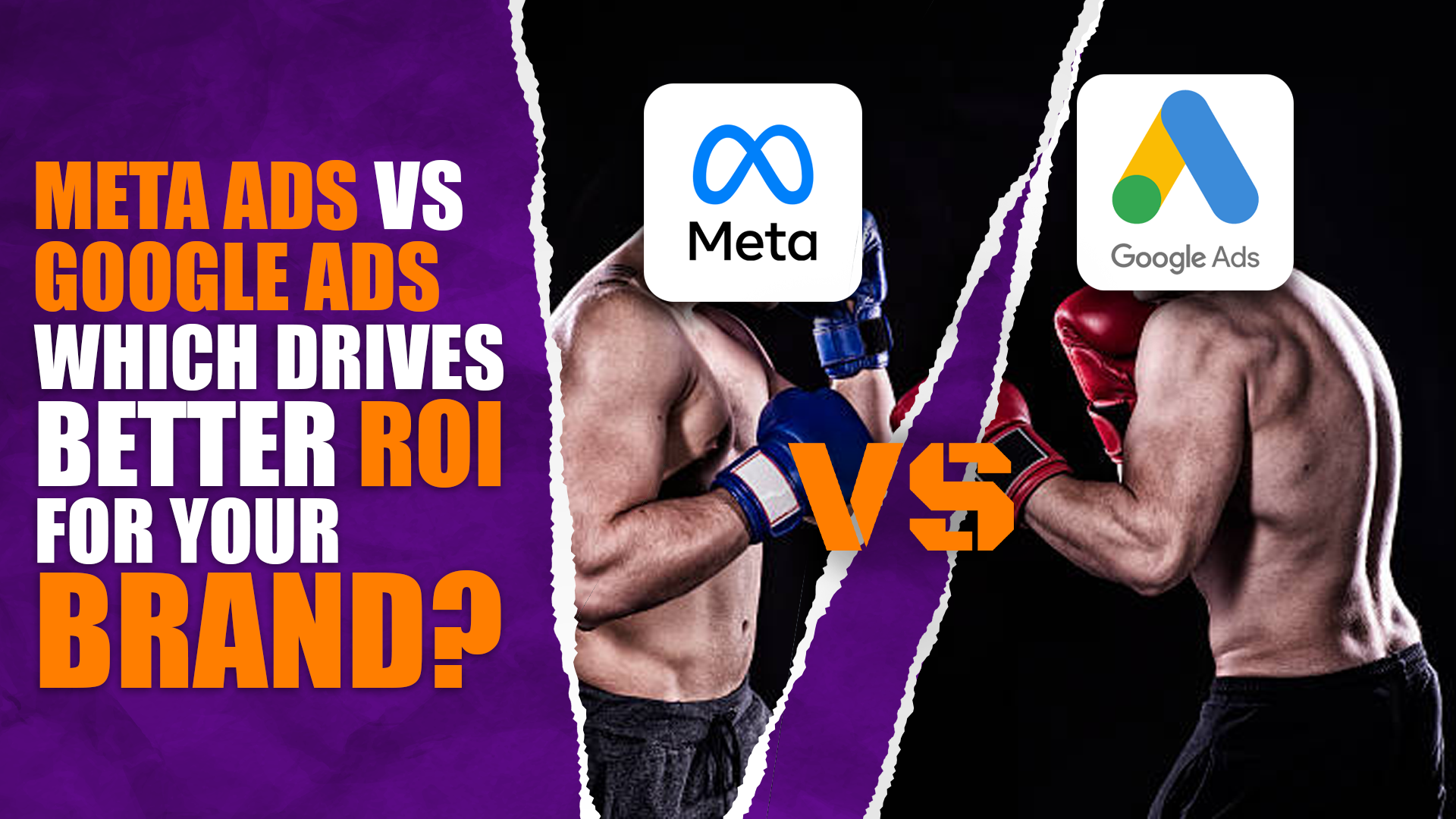
Marketers love a binary fight: “Meta vs Google.” But in reality, they don’t compete, they complement.
The real question isn’t which is better overall, but rather which drives the best ROI for your specific funnel stage, industry, and audience intent.
At The Brand Labs, we’ve managed millions in ad spend across both ecosystems. What we’ve learned is simple:
The brands that win aren’t choosing between Meta and Google, they’re architecting how both amplify each other.
Here’s a deep breakdown of how each platform performs, what drives ROI, and how to design a dual-platform strategy that compounds results instead of splitting focus.
1. Understanding the Core Difference: Demand Capture vs Demand Creation
Let’s start with the fundamental distinction that determines everything that follows.
| Platform | Primary Function | User Intent | Ideal Funnel Stage |
| Google Ads | Captures existing demand | High intent — users are actively searching for a solution | Bottom of funnel (BOFU) |
| Meta Ads (Facebook + Instagram) | Creates demand through interruption & inspiration | Low to medium intent — users are browsing or exploring | Top & middle of funnel (TOFU/MOFU) |
Google Ads intercepts intent: you’re bidding to appear where someone is already searching.
Meta Ads manufactures intent: you’re introducing a brand, shaping perception, and nurturing curiosity.
Expert Take: If Google Ads are like a fishing net (catching what’s already swimming), Meta Ads are like building the lake itself.
2. ROI in Context: How Each Platform Generates Value
ROI doesn’t exist in isolation — it depends on your cost per acquisition (CPA), lifetime value (LTV), and time-to-conversion window.
Google Ads ROI Mechanics
- Pros:
- High intent = faster conversions
- Clear attribution (search → click → purchase)
- Scalable keyword control and remarketing
- Cons:
- Saturated CPCs in competitive niches
- Short-term performance bias (rarely builds brand equity)
- Relies heavily on landing page UX + CRO
Data Insight: For eCommerce, average Google Ads conversion rates hover around 4–6%, with CPAs often 2–3x higher than Meta Ads — but conversions happen 2–4x faster.
🎯 Meta Ads ROI Mechanics
- Pros:
- Low CPMs and broad reach
- Exceptional for brand discovery & retargeting
- Rich creative testing (visual storytelling + emotion)
- Cons:
- Attribution complexity (view-through conversions often ignored)
- Declining signal accuracy post-iOS 14
- Fatigue-prone audiences → constant creative refresh needed
Data Insight: Meta often delivers lower CACs (cost per acquisition) in early funnel stages but longer payback periods, since it’s building brand familiarity first.
3. Funnel Economics: When to Use Each Platform
High-ROI ad strategies don’t choose, they sequence.
Top of Funnel (TOFU): Awareness & Engagement
- Meta wins here — hands down.
- Creative storytelling + video ads generate emotional connections.
- The algorithm optimizes for attention density, not just clicks.
What Works:
- UGC (user-generated content) ads
- Short-form videos (3–8 seconds)
- Interest-based lookalike audiences
Goal: CPM efficiency and engagement metrics (CTR, video watch %, saves).
Middle of Funnel (MOFU): Nurture & Education
This is where smart brands blend Meta + Google.
- Use Meta retargeting to re-engage viewers from awareness campaigns.
- Use Google Display & YouTube to stay visible during the research phase.
Pro Tip: Integrate your CRM or email system, when someone clicks a Meta ad, sync their event data to target them on Google later with intent-aligned keywords.
Goal: Engagement → intent amplification.
Bottom of Funnel (BOFU): Conversion
- Google Search Ads dominate here.
- Users are ready to buy, compare, or sign up.
- Conversion rate optimization (CRO) on landing pages becomes the multiplier.
Goal: Lower CPA, shorter time-to-conversion.
4. Attribution Reality: The Data You’re Probably Misreading
If you’re judging Meta Ads solely by “last-click” data, you’re underreporting their ROI by 30–60%.
That’s because Meta’s influence is largely view-through, someone sees your ad, doesn’t click, but later Googles your brand and converts via Search. Google then gets the credit.
Fix It with Unified Attribution:
- Use UTM parameters to distinguish assisted conversions.
- Analyze cross-channel paths inside GA4 or Triple Whale.
- Evaluate Meta’s performance in incremental lift, not last-touch ROI.
Expert Insight: The highest-performing brands use post-purchase surveys to identify awareness sources, 40% of customers think they found you on Google, but were primed by Meta.
5. Creative vs Copy Leverage: How Each Platform Demands a Different Mindset
Meta Ads → Creative is the Algorithm
- Visual-first, emotion-driven
- CTR lives or dies on pattern interruption
- The creative must do 80% of the persuasion work
Winning Strategy: Test hooks, not headlines. Meta’s algorithm amplifies creative that triggers early scroll-stops.
Google Ads → Intent is the Algorithm
- Keyword-first, logic-driven
- The ad’s success depends on alignment between search query → ad copy → landing page
- Micro-copy optimization (headline & description A/B testing) matters more than visual creativity
Winning Strategy: Bid on long-tail, high-commercial-intent phrases (e.g., “custom web design agency for startups” instead of “web design agency”).
6. Cost Efficiency: The Hidden Math Behind ROI
ROI isn’t just revenue divided by spend — it’s spend efficiency across funnel velocity.
| Metric | Meta Ads | Google Ads |
| Avg. CPC | $0.50–$1.50 | $1.50–$5.00+ |
| Avg. CPA | $15–$45 | $30–$80 |
| Time to Convert | 7–21 days | 1–5 days |
| LTV Impact | High (brand equity) | Medium (transactional) |
| Attribution Accuracy | Low | High |
The Takeaway:
- Google delivers faster, measurable ROI, but at a higher acquisition cost.
- Meta delivers slower ROI, but compounds over time through brand lift and remarketing synergy.
When blended strategically, they can reduce blended CAC by 25–40%.
7. Scaling Strategy: When to Double Down on Each
- If your website converts under 2%, prioritize Google Ads first — you need high-intent visitors to refine CRO.
- Once your site converts 3–4%+, scale Meta Ads — you’re ready to create demand and capture mid-funnel engagement.
- Always allocate 20–30% of budget to cross-retargeting — your most profitable audience isn’t “new” or “existing,” it’s familiar but not yet converted.
8. The Brand Labs Approach: Full-Funnel ROI Architecture
At The Brand Labs, we don’t ask “Meta or Google?”
We ask, “Where does your brand’s conversion bottleneck exist?”
Our performance methodology:
- Map buyer psychology across funnel stages.
- Layer creative & intent data to build cross-platform ad ecosystems.
- Use CRO loops to continuously compress CAC while increasing LTV.
The result?
A faster feedback loop, lower blended acquisition cost, and sustained compounding ROI, not isolated campaign wins.
At The Brand Labs, we help founders and marketers architect full-funnel performance ecosystems that unify Meta, Google, and CRO into one measurable growth engine.
Ready to find out which platform can 2x your ROI?
Book a Free Paid Ads ROI Audit, and let’s map your conversion potential.